Commit Poetry
In 1994, I stood in a polling station in South Africa, as lines of people snaked for miles across the fields of hope to vote for the first time. For three days of voting, the country, so filled with violence and fear in the months and years leading up to the election, celebrated peace, without any reported acts of violence. As an election observer, I saw first-hand voters marking their X next to their choice for President, most often the once banned African National Congress(ANC). Days later Nelson Mandela, the symbol of hope, of justice freed, mounted the steps outside of Parliament and took the oath of office as President. A monumental day - a colossal achievement – a step forward.
This achievement came after decades of small efforts by millions of people, wherein they held a vision that there could be freedom and that the dreaded days of Apartheid, the epitome of a system of separation and violence to the spirit, would someday end its stranglehold on the soul of a nation. A living manifestation of the words of Robert Kennedy that he so bravely delivered to his Cape Town audience 28 years earlier:
Each time a man stands up for an ideal, or acts to improve the lot of others, or strikes out against injustice, he sends forth a tiny ripple of hope, and crossing each other from a million different centers of energy and daring those ripples build a current which can sweep down the mightiest walls of oppression and resistance.
Here the mighty lay down their arms and we danced til’ dawn. .
Peace rarely comes from one giant achievement. It is about a change in the heart of each person. It comes from the sum total of all of our creative force as realized human beings. For it’s said, ‘Change in consciousness happens one person at a time.’ It’s how poetically we choose to live our lives, the seeds of our creative humanity we leave for others to savor, that can make a difference.
There’s something I’ve come to call the “Energetics of Protest.” It’s an unusual mix of philosophy about dissent that came from my background as a peace activist and human rights lawyer, and merged with my explorations of holistic healing techniques and spirituality - a journey so many have been traveling.
The Energetics of Protest is about approaching your activism in a manner that relinquishes the result and lets your creative voice; your deep presence as a human being, stand alone as meaningful. For example, take 5 people standing on the corner with a sign, what can that do? The cynic scoffs, “They’ll never stop the war,” or honks and shouts “Get a job.” However, there is something that those 5 people are experiencing that even they may not recognize.
The first, is what I call the Spock Effect. For any of you raised on Star Trek, it’s “Dr”, not “Mr.” Spock. Dr. Benjamin Spock, became a leader and a symbol for the protests against the war in Vietnam, often going to jail and speaking up in ways that lent voice to millions of other people. Yet, he had never thought about activism or getting involved until one day, while working in Washington DC, he drove by a small group of women protesting outside the White House. He was so moved by their symbolic act of courage that he made a commitment to get involved and the rest is history.
The second effect of the Energetics of Protest is on the participants themselves. Who knows if the young person standing to your right, becomes so empowered by opening their voice and taking a stance, that they go on to become a U.S. Senator, or a conscientious CEO, or a better teacher, manager, or spouse. We thought we were there to stop the war, but we were really there for that other person…for each other. Gandhi so wisely said “The hatred of thousands is offset by the light of one loving heart.” Never underestimate the power of your voice. The power of love. Your poetic presence.
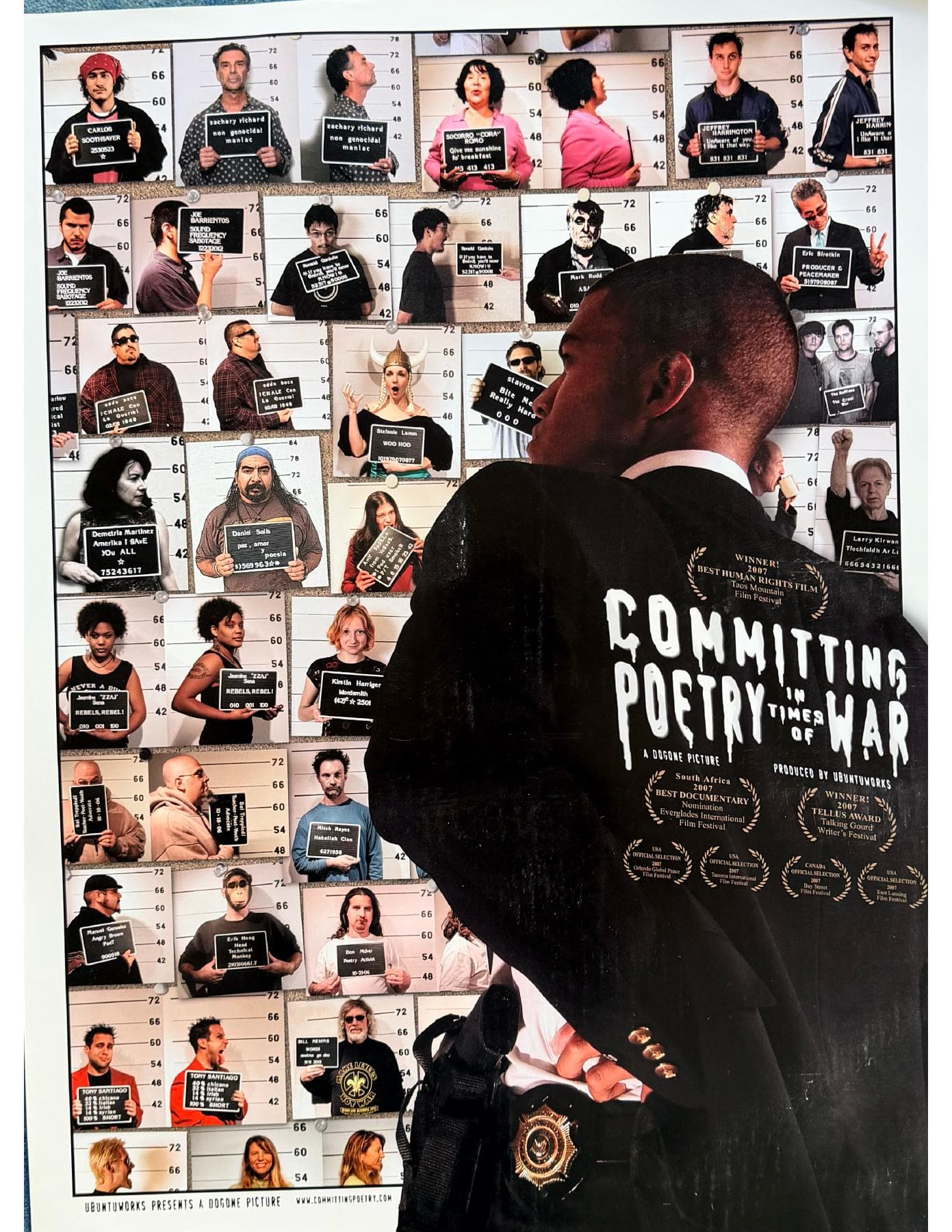
Lately, I have been involved in the creation and production of a film called Committing Poetry in Times of War. It has brought me into touch with the power of the words of slam poetry. As experienced by watching the film, this poetry goes right into your skin. The Ashland Daily Tidings recently wrote that it "Provides great insights into the human dilemma and our human potential” and that “the story unfolds through a visceral poem."
Poets have this effect on us. They remind us to feel life, not just figure it out. This is the Commit Poetry movement that is arising from the film. You don’t “commit poetry” by simply writing out a poem or even slamming a rhyme. But you commit poetry by choosing to live your life from your creative center – whether at work, at play or even in your outlook toward the world. Do we choose to live life in despair and anger, or from our hopes and dreams?
One great poet and playwright who helped a country through great change in a “Velvet Revolution,” was Vaclav Havel. His words help us in these trouble times, as they describe how hope kept him going, even in the hopelessness of imprisonment:
He says:
“The kind of hope I often think about, I understand above all as a state of mind, not a state of the world. Either we have hope within us or we don’t; it is a dimension of the soul…Hope is not prognostication. It is an orientation of the spirit, an orientation of the heart….it transcends the world, anchored somewhere beyond its horizons. It’s an ability to work for something because it is good, not just because it stands a chance to succeed.”
When we choose to live our life fully, stand for peace and commit poetry we renew our hope as a civilization. As Havel reminds us, hope is not about the state of the world, or what has happened in the past. It is a way of life. It goes on despite what the powers that be say or do. It is about trusting in the unknown, and in what is possible.
So it takes risk to stand on that corner with that sign - to choose to be a healer, rather than a destroyer. It takes risk to step up to the mic and speak a poem. It takes risk to stand for peace so deep in your heart in a time fraught with war or conflict.
It takes risk to buck how we are supposed to live and commit to creating the world we want to live in.
So I woke up today to learn that I’ve become a “creationist.” The debate seems often limited to a God “created” world vs. our evolution from Apes. But the stories go much deeper. With evolution there is a rather strict scientific timeline to things, a natural sequence…a hard hill to climb if you want to question it. It is meant to be a certainty. It happened this way only. Little room for real creativity and imagination. The experts tell the people how we got to where we are.
But creation to me is about the human spirit. God’s creation, not outside, but within our own bodies. It’s the idea that WE can create a new world for ourselves in 7 days …or less. This creation arises from the core of our creativity. Creativity is not about being an artist in the traditional mode of pastels and watercolors. On that level many of us would fail miserably. The deeper side of being an artist is the revelation that our lives are the canvases, and the paint the choices we make each day…each moment.
Finding our creative poetic side is about remembrance …remembering that WE create our lives and the conditions in which we operate. In the Jungles of Chiapas, the Zapatista Movement drew so many people to its message because it refused to assume the label of a traditional revolutionary group. Subcommadante Marcos became a leader, not because of ruthlessness or success in warfare, but because of WORDS! “We are Untied,” he said, “by the imagination, by creativity, by tomorrow….We can believe, its worth believing, we should believe in ourselves. Health to you, and don’t forget that flowers, like hope, are harvested.”
So I urge you today to take the world and its oft-tragic face and remember its flowered poetic core. Albie Sachs is an historic South African Figure. He now sits as a Justice on the Constitutional Court, but as an in exile ANC operative he was teaching law in Mozambique in 1988 when he left to his car to head home. As he opened the door someone called out his name and he turned away for a moment. That moment saved his life as the car bomb planted by the South African Defense Force operatives explored, taking some hearing and eyesight and taking off his arm forever.
He could have been bitter, angry and sought vengeance. Yet, as freedom approached I watched him in Cape Town as we celebrated the release of political prisoners that day from Robben Island, dance with such passion and joy. Some years later, after the Truth and Reconciliation process had opened up doors and hearts and realigned the truth behind the nation’s history, I heard him tell a story that is a deep reminder to us all about how we choose to live our lives.
One day in his chambers in South Africa, Justice Sachs had a visitor from a man named Henry. It turns out Henry had been the one who planted the bomb that tore apart Albie’s life forever. Henry had come to tell him that he was applying for amnesty for the crime and that he was sorry for what he had done and he hoped that Albie would support his amnesty petition and forgive him.
Albie was torn. He had helped create the laws around the Truth Commission, but this hit at such a personal core. Here was the man who had disfigured him. He was left without words. He told Henry to go and tell all that he had done to the Commission and that he would consider it.
Some months later Henry returned and told Albie that he had gone to the Commission and had told them everything. Albie took his remaining arm and shook Henry’s hand and said he forgave him. Later he asked someone about what had happened to Henry and learned that after he met with Albie, Henry had gone home and literally wept for days. Albie told us, “You can’t take back what happened. You can’t replace the arm, but you can make flowers grow from it.”
We can choose to be victims of the illusions of red and blue state, us and them, or the politics of fear; or we can decide to be in charge of our lives and to make each act a poem that demonstrates the best of our humanity. To have a tug of war you need both sides pulling. Let go! When you drop the rope you have stepped out of their paradigm, off the battlefield and gone closer to your real home - peace. Such an action is powerful beyond measure and it twists the logic of those left clutching the rope. It frees you to explore any direction, without being tethered to their worldview. It lets flowers grow from the ashes.
Deepak Chopra, in Peace Is the Way reminds us that “Anyone who knows how to move consciousness in an evolutionary direction is part of the peace movement?” Thus, the peace movement is much larger than who we might see in the streets. It’s those candles in the dark
• The thousands of people enrolled today in peace studies programs on 100’s of campuses,
• The thousands of kids at the First Amendment Center’s High School programs who are learning how to be true participants in a living democracy.
• The hundreds of thousands of kids getting mediation training in their schools at all levels.
• The volunteers in the million plus worldwide non-profits working on peace and human rights issues.
• The complimentary healthcare programs, the exploration of holistic principles in all walks of lives.
• The emerging independent digital film industry, new filmmakers telling our stories. The spiritual cinema circle, Utube, My space, the internet… stories being told, people sharing, in ways never imagined a few years ago.
And in virtually every city of the world, there is as you read this, some group of people talking about peace, organizing events, and working to change the dialogue.
For me I have found my creative avenue in Film production….taking a mix of poetry, free expression and justice, and weaving a story that makes people not only want to speak out, but to write or share their poetry. But each of us can find our own avenue.
So it’s not about quantity. Simply open your eyes at some creative gathering, some event that yearns for peace and justice, and look around you. Standing next to you, may be a person who will leave inspired and touch 10, 100, or tens of thousands of people with something that keeps hope spinning, something that spreads love beyond this field, and reminds us of our power to make a difference. Most often we never hear what that other person does. But know it’s happening.
So live life, not as a dissertation, but as a poem. In work, in play, in politics…. in life. Commit Poetry…not just in Times of War…but everyday. Go out and spit your rhyme.
The time is now.
This article is adapted from Eric Sirotkin’s keynote speech at the Ashland Peace Fair.